Blake's return from the sea
The light house: A love storyBlake's return from the sea is the climactic physical and emotional reversal of his struggle with grief. After Connie Dixon confronts him about the hollowed-out life he has built around Chloe's death, Blake McGrath falls into the surf, is carried offshore, nearly surrenders to death, and then hears Connie's voice guiding him back. His survival does not erase his blindness, his memories, or his sorrow; it changes his relation to them, making possible a life in which remembrance and renewed love can coexist.
Causes and Background
The return begins in conflict rather than rescue. Blake has told Connie that she must leave him because he fears she will remain only out of pity. He presents his blindness and grief as an identity from which neither of them can escape, and he urges her to leave the darkness to him. Connie answers that blindness is not the central problem: the greater danger is the sadness and self-pity that have filled his heart so completely that there is no room for her. When Blake insists that he wants to be left alone, Connie finally pushes him backward with all her strength.
The setting gives the confrontation an exact symbolic pressure. They are standing at the shoreline, where the surf hisses around their feet and pulls at the sand beneath them. Blake, sightless and already emotionally withdrawn, loses his balance when Connie pushes him. He falls into the water, and the sea immediately turns the argument into a struggle over life, death, and personal responsibility. Connie's action is neither a simple attempt to harm him nor an ordinary act of rescue. She recognizes that continuing to carry Blake back from every crisis would leave him dependent on the grief he claims cannot be changed.
The episode also reverses Blake's established relationship with the ocean. He and Ned have gone to the beach at sunset to send a rose into the sea for Chloe, while Ned waits through the night for her return. Blake has kept every light in the house burning so that Chloe might find her way home. The beach has therefore been both memorial ground and prison: it preserves his bond with his daughter, but it also keeps him enclosed within the moment of her drowning. His return from the sea begins when that ritualized surrender is interrupted by an immediate demand to survive.
The Near-Drowning
The current carries Blake fifty feet offshore, beyond the point where he can feel the bottom. He cries for help, calling Connie's name as successive waves wash over him. Connie enters only as far as the water around her hips and refuses to swim out to him. The ocean's pull is so strong that she feels it as a force clawing at her, yet she continues to call him toward her, telling him to listen to her voice and come back.
Blake's body passes through successive stages of panic, exhaustion, and surrender. Salt water burns his throat; he is repeatedly submerged, loses orientation, and gulps for air whenever his head breaks the surface. When he can no longer sustain the struggle, a creeping tranquility overtakes him. He releases his last breath in the water and begins to drift, while visions of Chloe appear behind his blind eyes. In the vision she is a child running along the sand, laughing with the trust and adoration of a daughter who still belongs wholly to the living world. The memory offers Blake a final, intensely intimate encounter with the child he lost, but it also accompanies his apparent movement toward death.
The decisive change comes when Blake suddenly understands that he does not want to die. His survival instinct returns with renewed force, and he begins thrashing toward the surface. Connie's voice first reaches him faintly, then grows louder and more urgent. He turns toward it, stays above a smaller wave, and begins to swim. His waterlogged jeans, exhausted legs, and aching body make every movement difficult, but a wave carries him closer until his foot touches sand.
Blake reaches the shallows as a survivor rather than as a man passively reclaimed by the sea. He drags himself upright, stumbles on legs that can scarcely support him, and advances one step at a time. Connie remains only a few feet away, holding out her hand but resisting the impulse to lead him ashore. She tells him to come to her while leaving tragedy and the past behind, not by forgetting Chloe, but by coming back without the debilitating sadness that has governed him. When his fingers finally touch hers, she embraces him, crying with relief and joy.
Consequences and Aftermath
The immediate consequence is physical survival, but the deeper consequence is Blake's recovery of agency. Connie's voice gives him direction, yet he must orient himself, fight the current, swim, find the sand, stand, and walk. The scene therefore makes his return an act he performs rather than a favor someone performs for him. His blindness remains, and the ocean remains dangerous, but he is no longer surrendering his entire future to the fact of his loss.
The embrace confirms that Blake's return is also a return to relationship. He realizes that Connie's love is everything he wants, and more than he believes he deserves. Their reconciliation does not replace Chloe or cancel the years of grief. Instead, it establishes a distinction between remembering Chloe and remaining imprisoned by the tragedy. At sunrise, while the waves still move around them, the light becomes a renewed promise: the same coast that held Blake's trauma now witnesses his willingness to begin again.
Blake immediately identifies the unfinished task that follows survival. He tells Connie that he must say to Chloe the one thing he could never bring himself to say: goodbye. The farewell is enacted at sunset, when Blake and Ned return to the beach with the last red rose. This final ritual preserves the emotional truth of his bond with Chloe while ending the expectation that she will somehow return through the sea. The rose becomes not an invitation home but a release, allowing Blake to carry memory without continuing to wait for the impossible.
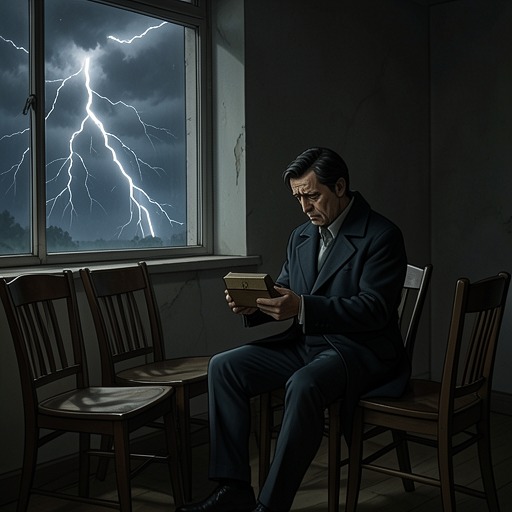
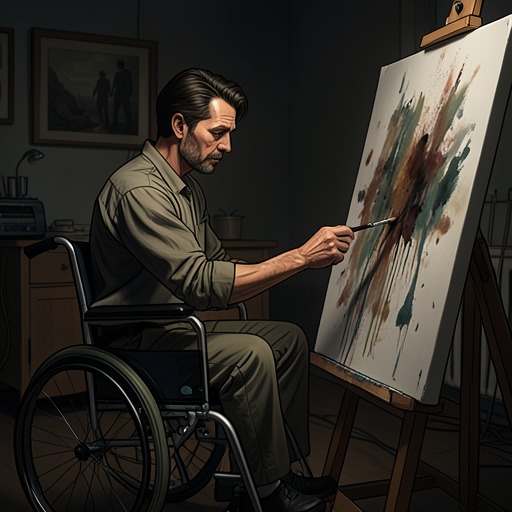
The change extends into Blake's domestic and artistic life. After sharing the pain of Chloe's death with Connie, he feels a burden lift; his grief does not vanish, but a glimpse of his former self begins to rise from despair. He can dust Chloe's bedroom and change the sheets, an ordinary act that marks movement from memorial fixation toward inhabitable life. Later, at the opening of the Connie Dixon Gallery of Fine Art, he publicly acknowledges that Connie lifted him from darkness and states that he will return to the easel, not to paint seascapes or portraits, but to paint emotion. His return from the sea thus becomes the bodily beginning of his return to art.
Narrative Significance
The event condenses the book's central contrast between the ocean as muse and the ocean as source of trauma. Earlier, Blake's nightly beach practice and the ever-lit house turn the coast into a landscape of continuing attachment. During the near-drowning, that same landscape threatens to erase him. His movement back through the surf changes the meaning of the place without making it benign: the ocean remains powerful enough to kill, but it no longer possesses the final claim over Blake's identity.
The scene also dramatizes grief as a fluctuating process rather than a clean disappearance. Blake moves from memorial practice and recollection to emotional collapse, from surrender to an awakened will to live, and finally toward a form of farewell. Connie's presence makes recovery possible, but the narrative does not make her a substitute for Blake's own decision. She refuses both to abandon him and to remove the consequences of his choices. Her voice offers connection; Blake's swimming supplies the act of return.
Because the episode joins bodily danger, recognition, reconciliation, and future artistic purpose, it functions as the novel's central reversal. Blake enters the sea as a man convinced that suffering is the only authentic form of loyalty to Chloe. He emerges still blind and still marked by loss, but capable of love, farewell, and creation. His return is therefore not merely a rescue from drowning. It is the moment when survival becomes a moral and artistic choice.